Home
Products
Approach
Industries
Company
Contact
Home
Products
Approach
Industries
Company
Contact
Customer: Global Semiconductor Manufacturing Equipment Company
Outcome: materialsIN rapidly generates scientifically-grounded recommendations and shortlists of precursor candidates for experimental evaluation in advanced process development.
THE CHALLENGE
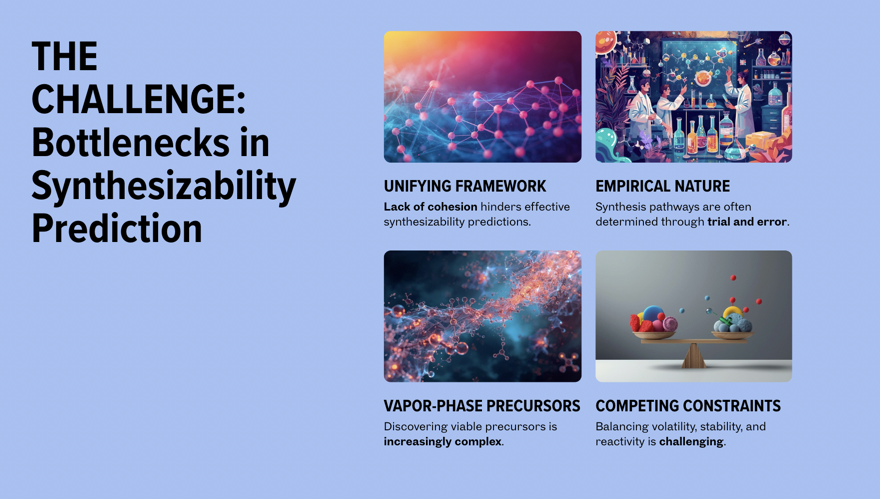
Advanced microelectronic devices require continuous innovation in materials and deposition processes to sustain performance scaling. Predicting synthesizability remains the primary bottleneck to accelerate the transition from theoretical materials discovery to practical fabrication. Unlike the discovery phase, there is no unifying theoretical or experimental framework that reliably predicts whether a material can be synthesized or provides a viable fabrication recipe. As a result, identifying synthesis pathways and processing conditions still relies heavily on empirical iteration, forming a fundamental barrier to rapid commercialization.
A global leader in semiconductor manufacturing equipment needed to explore next-generation low-dielectric-constant (low-k) thin-film materials that rely on complex multi-component coordination networks deposited by vapor-phase techniques such as atomic and molecular layer deposition (ALD/MLD).
A fundamental barrier to experimental progress was the identification of suitable vapor-phase precursor molecules that satisfy stringent, often competing, constraints: sufficient volatility, thermal stability, controlled surface reactivity, and compatibility with self-limiting ALD/MLD reaction cycles. Traditional trial-and-error precursor discovery is slow, expensive, and high-risk, particularly when exploring unfamiliar multi-metal or ligand-mediated reaction spaces.
The company, led by an R&D team, engaged materialsIN to accelerate and de-risk early-stage process development by creating a scientifically grounded, data-driven method to identify and prioritize viable precursor candidates for experimental evaluation.
THE APPROACH
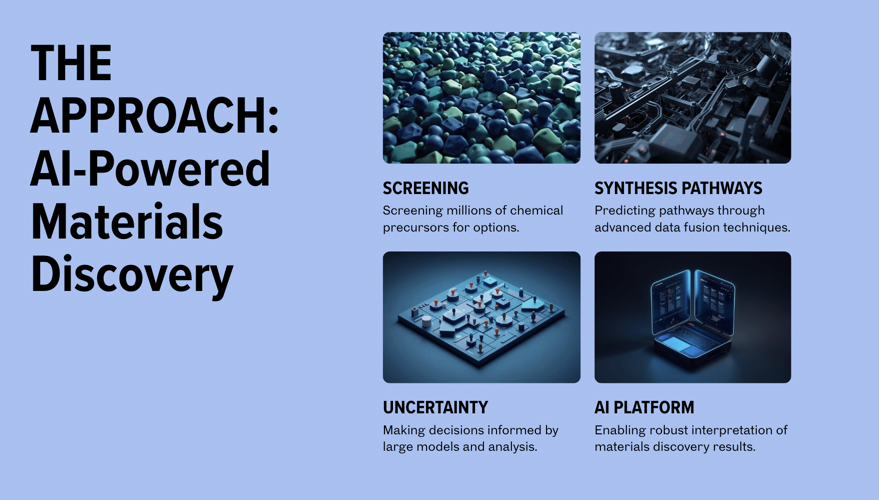
materialsIN applied its proprietary materials informatics and machine-learning methodology to develop a systematic precursor screening and ranking framework grounded in the foundational principles of organic chemistry. Its key elements include:
THE RESULTS
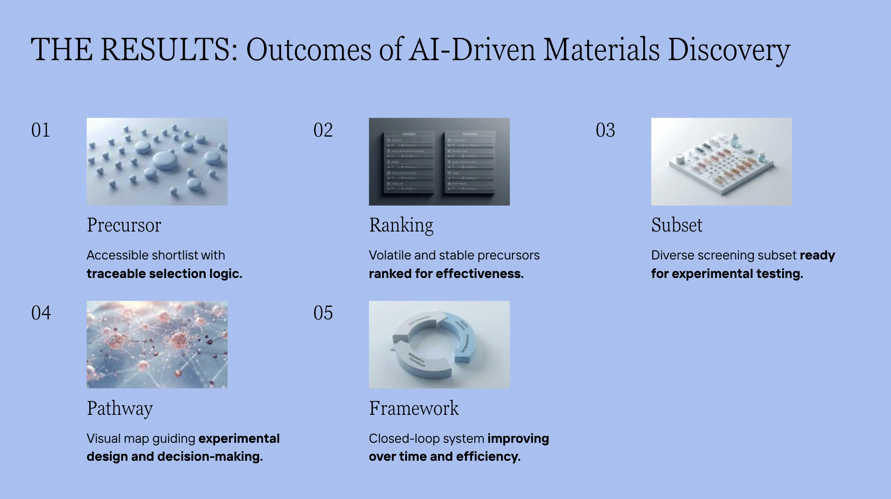
materialsIN delivered a scientifically defensible, vendor-accessible precursor shortlist, along with a transparent selection logic linking molecular features to process feasibility.
Key outcomes included:
This approach allowed the client to transition from conceptual materials targets to experimentally actionable precursor screening while substantially reducing early-stage discovery time and risk.
THE IMPACT
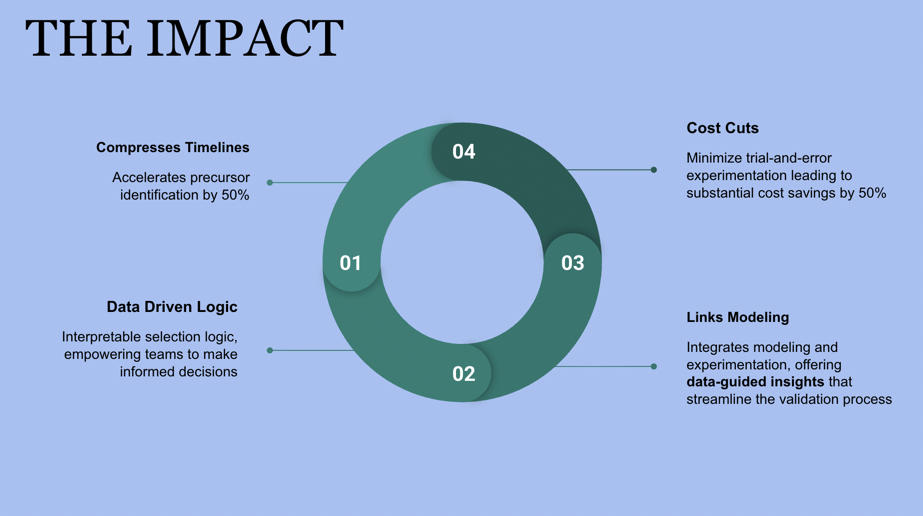
The engagement demonstrates how materialsIN’s materials-informatics platform accelerates precursor discovery for advanced semiconductor process development in that it:
By delivering ranked precursor shortlists and a reusable discovery framework, materialsIN equips semiconductor manufacturers to explore emerging deposition chemistries with higher confidence, lower cost, and faster time-to-experimental validation, and accelerates the introduction of products into the market